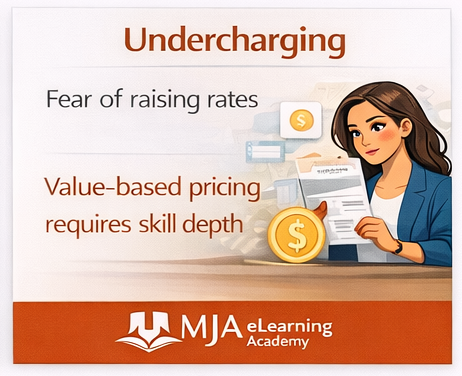
Undercharging rarely begins with numbers.
It begins with hesitation.
You deliver strong work.
Clients are satisfied.
But when it is time to raise your rates, resistance surfaces.
The root tension is clear:
Fear of raising rates
That fear is not about greed.
It is about certainty.
And certainty is built through structure.
🔎 What Fear of raising rates Really Signals
Fear of raising rates often reflects:
• Unclear differentiation
• Limited specialization
• Weak outcome articulation
• Lack of measurable proof
• Comparison-driven pricing
When pricing feels fragile, it usually means positioning is fragile.
Pricing is not emotional.
It is structural.
📉 The Cost of Staying in Undercharging Mode
Undercharging creates:
• Revenue ceilings
• Overwork
• Resentment
• Burnout risk
• Limited reinvestment capacity
It also shapes perception.
Low pricing often signals low authority, even when skill is high.
Clients anchor value to positioning.
🔁 The Structural Reframe
Value-based pricing requires skill depth
Skill depth is what transforms:
“I complete tasks.”
Into:
“I drive outcomes.”
Value-based pricing requires skill depth because depth creates leverage.
Surface-level skill invites comparison.
Depth invites investment.
🧠 Why Virtual Assistants Hesitate to Raise Rates
Common patterns include:
• Fear of losing clients
• Inconsistent results tracking
• Undefined niche
• Limited confidence in specialization
• Lack of reporting structure
Fear of raising rates is rarely about arrogance.
It is about clarity.
🧩 The Value-Based Pricing Framework
If Undercharging is rooted in Fear of raising rates, here is the corrective structure.
Layer 1 — Define Outcome Ownership
Ask:
What measurable impact does my work create?
Examples:
• Increased engagement
• Improved email conversions
• Reduced operational inefficiency
• Higher client retention
Value-based pricing requires skill depth because impact must be articulated.
Layer 2 — Strengthen Specialization
Instead of:
“General marketing support.”
Shift to:
“Conversion-focused funnel optimization.”
Depth narrows focus.
Narrow focus increases authority.
Layer 3 — Integrate Data Reporting
Track:
• Conversion percentages
• Lead growth
• Revenue improvements
• Time saved through automation
Skill depth supported by metrics increases pricing power.
Layer 4 — Phase-Based Pricing Adjustments
Rather than sudden jumps:
• Increase rates with scope expansion
• Add strategic review sessions
• Introduce reporting layers
• Transition project clients to retainers
Raise value before raising rates.
📊 Example Comparison
Task-Based Pricing:
$800 monthly for content posting.
Value-Based Pricing:
$1,500 monthly for structured visibility and conversion system management, including analytics reporting and optimization.
Same professional.
Different depth.
Value-based pricing requires skill depth because it reframes service as strategy.
🌿 Emotional Shift
Undercharging feels safe.
Until it becomes limiting.
When Fear of raising rates is replaced with structured confidence, negotiation becomes calm.
You stop defending.
You start leading.
🚫 Mistakes That Reinforce Undercharging
• Avoiding specialization
• Ignoring performance metrics
• Competing on cost
• Apologizing for pricing
• Skipping structured reviews
Pricing is not persuasion.
It is positioning.
👩🏽💼 Why This Belongs in AI Strategy
Inside AI Strategy, we focus on:
• Data-backed performance reporting
• Revenue-aligned positioning
• Automation-driven efficiency
• Strategic optimization cycles
Value-based pricing requires skill depth because AI-enhanced systems amplify measurable impact.
Measurable impact justifies premium rates.
🔄 The Premium Growth Loop
Develop skill depth
↓
Measure impact
↓
Communicate outcomes
↓
Elevate pricing
↓
Reinvest in skill expansion
This loop stabilizes revenue and authority.
📌 The Professional Shift
When you eliminate Fear of raising rates, you eliminate income stagnation.
You move from hourly thinking to outcome ownership.
And ownership builds confidence.
If you recognize yourself in this pattern, you’re not alone. Most Virtual Assistants were never taught structural positioning.
Click the link to download the Strategic VA Shift™ Framework.
If you’re ready for deeper implementation support, schedule a 15-minute clarity session with MJA eLearning Academy.