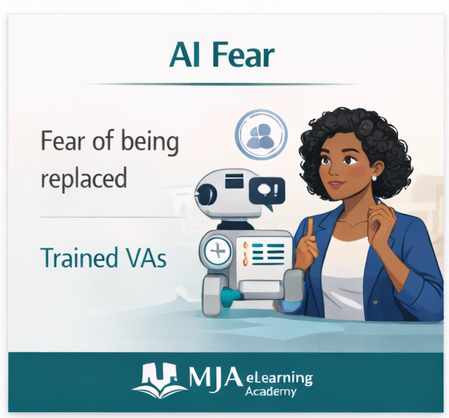
You read another headline.
“AI is replacing jobs.”
You wonder quietly if Virtual Assistants will be next.
It is a reasonable concern.
But fear without context can distort opportunity.
🔎 The Hidden Problem
The real threat is not AI itself.
The real threat is stagnation.
When VAs rely only on manual processes, automation appears competitive.
But when VAs understand AI tools strategically, those same tools become leverage.
AI does not eliminate roles that evolve.
It eliminates roles that remain static.
⚠ Why This Happens
Many Virtual Assistants are exposed to AI through fragmented information.
Short videos. Quick prompts. Surface-level tutorials.
Without structured learning, AI feels unpredictable.
That unpredictability creates anxiety.
Additionally, clients may experiment with tools independently.
If you cannot guide that experimentation, you risk being sidelined.
Fear grows where knowledge is shallow.
💸 What This Quietly Costs You
Avoiding AI does not preserve security.
It reduces competitiveness.
Clients increasingly expect efficiency.
They want faster content drafts, data summaries, automation suggestions.
If you cannot provide guidance, someone else will.
There is also a confidence cost.
Watching technology advance while standing still creates internal pressure.
Over time, hesitation becomes limitation.
🔄 The Required Mindset Shift
Trained VAs win.
AI rewards those who understand systems.
When you know how to integrate tools into workflows, you move from executor to implementer.
The question shifts from “Will AI replace me?” to “How can I implement AI for my clients?”
That is a powerful repositioning.
🧭 A Structured Framework to Solve It
- Understand Core AI Capabilities
Learn what AI tools actually do.
Content generation.
Data analysis.
Automation support.
Clarity reduces fear.
- Integrate AI into Existing Services
Do not abandon your services.
Enhance them.
Use AI to draft outlines.
Generate email frameworks.
Assist with research.
Position yourself as the interpreter of AI outputs.
- Design AI-Supported Workflows
Build structured processes where AI assists but does not replace you.
For example:
AI drafts.
You refine.
Client approves.
This layered model increases efficiency without sacrificing quality.
- Communicate Strategic Oversight
Clients need assurance.
Explain how you use AI responsibly, ethically, and strategically.
Oversight becomes part of your value.
🎓 Where Structured Training Fits
Experimentation alone is not enough.
Structured AI education provides confidence and clarity.
Programs like MJA AI Tools & Skills – AI Tools Training for VAs guide you through practical implementation, not just theory.
You learn how to apply tools within client systems.
That practical integration is what differentiates trained professionals from casual users.
📘 A Practical Starting Resource
If you are beginning your AI journey, start by strengthening your marketing foundation.
The guide Top 5 Digital Marketing Tips for Virtual Assistants helps you understand where AI fits within broader marketing systems.
AI is not a replacement for strategy.
It is a tool within it.
Understanding the system first prevents misuse later.
📈 Long-Term Growth Insight
Technology evolves.
Roles evolve with it.
Virtual Assistants who ignore AI may feel temporary relief.
Virtual Assistants who train in AI build long-term relevance.
The future does not belong to the fastest typist.
It belongs to the structured thinker who can combine tools, systems, and oversight.
Fear shrinks when competence grows.
And competence is a choice.
Ready to move beyond task-based work and build real digital marketing and AI systems skills?
Book a free 15-minute strategy call with me and I will help you identify the next best step for your goals.
https://calendly.com/mjaea/15min