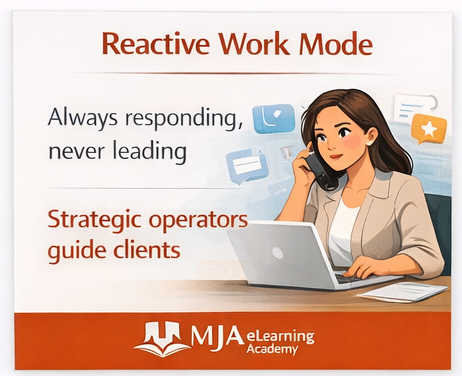
Reactive Work Mode feels busy.
It looks productive.
You respond quickly.
You answer emails.
You adjust timelines.
You accommodate requests.
But internally, something feels off.
You are moving constantly.
Yet you are not directing.
At the center of this pattern is one core pain:
Always responding, never leading
And when you operate in that space long enough, your authority erodes.
🔎 What Always responding, never leading Really Creates
Always responding, never leading often results in:
• Constant urgency
• Client-driven scope changes
• Reactive pricing conversations
• Emotional fatigue
• Limited strategic positioning
When clients set the direction, you become support.
When you set the direction, you become leadership.
Reactive mode feels efficient.
Strategic mode builds authority.
📉 The Hidden Cost of Reactivity
When you remain in Reactive Work Mode:
• Your calendar fills unpredictably
• Marketing becomes inconsistent
• Growth stalls
• Boundaries weaken
• Confidence declines
You are executing.
But not architecting.
And execution without direction creates ceiling effects.
🔁 The Structural Reframe
Strategic operators guide clients
Guiding does not mean dominating.
It means structuring.
It means designing the process.
It means setting expectations.
Strategic operators guide clients because they build systems clients can step into.
🧠 Why Virtual Assistants Drift into Reactive Mode
Common triggers include:
• Fear of losing clients
• Inconsistent pipeline
• Lack of onboarding structure
• Undefined deliverable scope
• No review cadence
Without structure, the loudest request wins.
With structure, priorities are pre-set.
🧩 The Strategic Operator Framework
If Reactive Work Mode is rooted in Always responding, never leading, here is the corrective structure.
Layer 1 — Structured Onboarding
Before work begins, define:
• Scope
• Communication channels
• Response timelines
• Review cycles
• KPI expectations
Clarity prevents chaos.
Layer 2 — Proactive Planning Sessions
Schedule:
• Monthly strategy calls
• Quarterly performance reviews
• Optimization checkpoints
When you initiate structure, authority strengthens.
Layer 3 — Recommendation Ownership
Instead of waiting for instruction, present:
• Suggested improvements
• Performance insights
• Workflow adjustments
• Growth opportunities
Strategic operators guide clients by anticipating needs.
Layer 4 — Decision Framework
Create guidelines such as:
• What qualifies as urgent
• What requires scope expansion
• What falls outside agreement
Boundaries reinforce leadership.
📊 Before and After Example
Reactive Mode:
Client: “Can you add this today?”
You: “Yes, I’ll adjust.”
Strategic Operator Mode:
Client: “Can you add this today?”
You: “That falls outside the current scope. I can include it in next month’s optimization plan or create a separate proposal.”
Same skill.
Different posture.
Strategic operators guide clients because they design direction.
🌿 Emotional Shift
Reactive Work Mode feels safe.
But it creates dependency.
Leadership feels uncomfortable at first.
But it creates respect.
Authority grows when structure replaces reaction.
🚫 Mistakes That Reinforce Reactive Mode
• Saying yes without reviewing scope
• Skipping performance reviews
• Avoiding strategic recommendations
• Responding instantly without prioritization
• Failing to document processes
Always responding, never leading is not service excellence.
It is structural weakness.
👩🏽💼 Why This Belongs in AI Strategy
Inside AI Strategy, we focus on:
• Process architecture
• Client leadership frameworks
• KPI-driven planning
• Automation-backed structure
Strategic operators guide clients because systems create direction.
Direction increases trust.
Trust increases retention.
🔄 The Authority Loop
Plan
↓
Guide
↓
Measure
↓
Optimize
↓
Elevate pricing
This loop transforms executors into advisors.
📌 The Professional Identity Shift
When you eliminate Always responding, never leading, you eliminate reactive stress.
You gain:
• Clear boundaries
• Confident communication
• Stable workflows
• Elevated authority
Leadership is structured.
Not emotional.
If you recognize yourself in this pattern, you’re not alone. Most Virtual Assistants were never taught structural positioning.
Click the link to download the Strategic VA Shift™ Framework.
If you’re ready for deeper implementation support, schedule a 15-minute clarity session with MJA eLearning Academy.